Wednesday, March 11, 2009

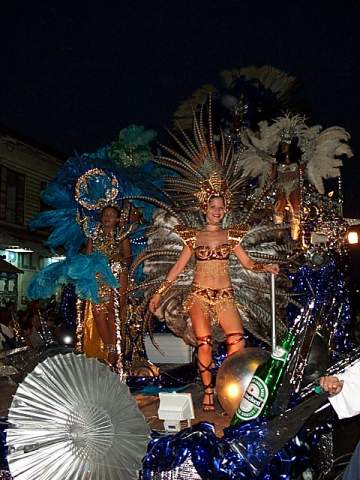
GUYANA CARNIVAL


This carnival was born at the same time as Guyana itself. When Europe set out to conquer America, it took with it the christian's tradition of carnival.

The colonists celebrated then the carnival in front of the slaves who didn't have the right to participate to it. But can we forbid the laughter, even suffocated, the dance, the party? The colonists were afraid from these evenings of fiest, so they forbade some dances, destroyed drums... But the universal spirit of the carnival was there. It joined the African fiest of the harvest and the fertility. The Christian's carnival, imported by the conquest, was only resuming these old parties so ancient for the man. Interbreeding of European and African party, the carnival acquired an appropriate personality whom we can find only in Guyana.
It is doubtless the longest carnival of the world. He begins after Epiphany to end the Ash Wednesday.

The carnival is also a memory's place. Its characters are pulled out by the history of the country. For example, "neg maron" represents the slaves who, during the slavery period, ran away, have " marroné ". Some neg' marons became famous so the tradition lent them extraordinary powers. In the parade of the carnival, "neg maron" has a red banner in his hair, a kalimbé in the size and especially he covers his body of soot's oil. He uses this black and brilliant mixture to make the most curious spectator move back and so clear the passage.
Next to traditional costumes are born the inventions of the modern carnival. New costumes make more reference to the media, to the society than to the history of the country.

Guyana lives at the tempo of its carnival. Musicians, wardrobe master work all year to honor her Majesty Vaval who is burnt the day of Ash Wednesday and who resuscitates theEpiphanie's day of the next year.

Monday, March 9, 2009

The guadeloupean's carnival

Enjoyment and mockery ( sé kannaval ki ka rivé,toùt moun an lari-la...).

The carnival called by the inhabitants of Guadeloupe ' Kannaval ' or simply ' Vaval' begins the Epiphany's day and finishes the wenesday of ashes. This year, since January 1st, the carnavaliers groups, gathered.
The carnival was created when the African slaves were deported to the Antilles to be used by the colonists. At the beginning,the carnival was only practised by the colonists. More and more , the slaves began to celebrate the carnival! They brought a totally different vision to the carnival, with drums, songs and masks. This moment is always considered as a liberation, in fact they laughed from colonists through their suits.
Progress of the festivities:
Masks are omnipresent during the carnival (Some young people takes advantage from it to earn some money). The most important places are "The cities of Pointe-à-Pitre" and "Basse-Terre" . Several competitions are organized like the election of king, queen, the best group, the best suit, the best music etc...
The elected Queen has got to throne at the head of the parades during fat tuesday. The music of the parades is particular. Guadeloupean use diverse objects of recovery (bottles, tins of plastic, salty meat of different size).
The groups are divided into three categories according to their music:
- the groups with copper. They use instruments craft as snare drums, big plastic drums.
- the groups with skins. They use small drums covered with animal's skins, with traditional instruments (exemple: whipes).
- the groups of synthesizers .These groups exist for ten years. Besides the traditional instruments, they have appealed to more modern instruments.
Monday is dedicated to the comic marriages. Couples appear in front of a guy disguised as an officer of registry office and another one in priest. The man is disguised as a woman and the woman is dressed up as a man.
The Shrove Tuesday is the most important part of the carnival due to the musical level, the disguises, the originality... The festivities are opened by the carnival's queenThe culinary speciality of Shrove Tuesday is the consumption of doughnuts.
The next day, on Ash Wednesdays the crowd disguised in black and white, in sign of mourning, burns the effigy of king Vaval.

Wednesday, March 4, 2009

Venice's carnival: nowadays

As everybody knows, we are actually in the Lent period. Carnivals are finished, and for the luckiest one, you have been able to take part at one of those important events, beginning once more time every years.

In a few days, we'll show you how we did it in our school, but actually, we'll just finish the description of the Venice's carnival. ;)

First, we should say that carnival no longer mean that a doge has been victorious, it is just a touristic event. A world of dreams opens its doors for a few days, allowing people to drink and eat delicious things, to flirt, to escape from real life.
The mask is the symbol of the carnival. Every year around the world, anyone understand that this bauta, even not knowing the real name, is associated to Venice. It's possible for mascherari to make impressing masks which are usefull only a few days every year.
Some important events occurs during those few days. This year, the official edition of the carnival was: "Sensation, 6 senses for 6 districts" The aim is to divide the city in different geographic parts where people can profit differently of the carnival. If you want to use your nose, many parfums could be smelt in Santa croce, whereas you can hear beautiful musics at Dorsoduro, taste wonderful food at Cannaregio, touch at Castello, watch at san Polo and think at san Marco. Everyone should find what is the most interesting for him/her.
There is also a something for young children: the best mzsked and costumed child earn an award, many art expositions are opened, some people are costumed in dinausorus ( you need to see it to believe it!), many animations for both children and their parents, theatres are opened, the angel flight is during the first sunday...
The only problem is to stay there... Hotels are all empty many months ago!!!