If you love France…
If you have loved the Venice carnival…
You will love the nicest French carnival… The Nice’ carnival!!!
Historically, the first reference comes back to 1294 when “Charles d’Anjou” does a reference to it. A funny, well, an interesting detail is that Rio’s carnival seems to come from Nice’ carnival.
The modern one was born in 1873.A man decided to give more importance to the carnival, and to coordinate efforts. Floats are made, and some are very particular...
- Since 1873, loads of floats are made more original one than another. The aim is of course to impress both visitors and Nice’ people.
- The flower battle is not an historic battle, but a big parade composed of 20 floats entirely decorated with flower that give a wonderful mosaic of colours and perfume. And it’s not imported flowers! (Not too much...) It’s local production, real French flowers! People over those floats send hundreds of flowers over people came to see this demonstration.
- The train “of pleasure”, floats of music, “its majesty carnival”, official song of the carnival... The comity has an imagination without end when it is a question to find new ideas...
Nowadays, there are also big mechanized bots. Creativity, imagination, talent... Nice has everything to make himself one of the best carnival in the world, even if it is not really famous. If you have the luck one day to go there.... don’t forget to send us photos!!!
Wednesday, April 29, 2009

CADIZ CARNIVAL, SPAIN
Cadiz‘s carnival is one of the most famous carnival in Spain with the carnival of Santa Cruz de Tenerife.
The carnival of Cadiz seems to be like the Christians heritage. Its first signification is that it’s authorized to eat all kind of appetites which are prohibited during the lent period.
The Carnival is, with its signification social and psychological, equilibrated in all kind of subjects, even if in 1523 Carlos I banned the wear of masks.
With the time, a different carnaval was born in Cadiz. Cadiz met a big influence from Italia in the XV Century during their moving to Turkish‘s Mediterranean sea.
Traders and storekeepers coming to Occident met in Cadiz a settlement very communicative with their commercial objectives: North and Centre of Africa.
Masks, confetti, and all the rest are elements assimilated from Italian carnivals.
Cadiz carnival occurs during eleven days without taking in the times for the competition, gastronomic acts, and general rehearsals, and the “carnaval chiquito “(small carnival), or “carnaval de los jartibles”.
During the carnival’s week we can see illegal groups in different sites from the town organizing competitions of chorus slide trays, ceremonials for the Greek gods like the Goddess of carnival, the burning of the God Momo, of the Witch Piti, popular activities etc..
From the first Thursday, to the final Sunday is standing a big tent for disguised dances.
The different folk song you can hear there are : “tango”, “paso doble” ( double passing),” la parodia” ( the parody ), “el cuplé”(variety song), “ el estribillo “ ( the tune , sang by all the groups in the town together ), “el popurri” (potpourri) and , “el tema libre” (free theme ).
All the music done by boxes, bass-drum, guiro, guitars, keys and kazoo !
Now let’s get enjoying the festivities of carnival in south of Spain, you will like Andalusia! )
The carnival of Cadiz seems to be like the Christians heritage. Its first signification is that it’s authorized to eat all kind of appetites which are prohibited during the lent period.
The Carnival is, with its signification social and psychological, equilibrated in all kind of subjects, even if in 1523 Carlos I banned the wear of masks.
With the time, a different carnaval was born in Cadiz. Cadiz met a big influence from Italia in the XV Century during their moving to Turkish‘s Mediterranean sea.
Traders and storekeepers coming to Occident met in Cadiz a settlement very communicative with their commercial objectives: North and Centre of Africa.
Masks, confetti, and all the rest are elements assimilated from Italian carnivals.
Cadiz carnival occurs during eleven days without taking in the times for the competition, gastronomic acts, and general rehearsals, and the “carnaval chiquito “(small carnival), or “carnaval de los jartibles”.
During the carnival’s week we can see illegal groups in different sites from the town organizing competitions of chorus slide trays, ceremonials for the Greek gods like the Goddess of carnival, the burning of the God Momo, of the Witch Piti, popular activities etc..
From the first Thursday, to the final Sunday is standing a big tent for disguised dances.
The different folk song you can hear there are : “tango”, “paso doble” ( double passing),” la parodia” ( the parody ), “el cuplé”(variety song), “ el estribillo “ ( the tune , sang by all the groups in the town together ), “el popurri” (potpourri) and , “el tema libre” (free theme ).
All the music done by boxes, bass-drum, guiro, guitars, keys and kazoo !
Now let’s get enjoying the festivities of carnival in south of Spain, you will like Andalusia! )
The carnival of New Orleans
The first Shrove Tuesday in Louisiana, March 3rd, 1699, was a ceremony in honour of the explorer René Robert Cavelier, who had given the naming of " no Shrove Tuesday " to a strip of land situated in the delta of the Mississipi, to hundred of kilometres in the South of the New intended Orléans.
And it was only in 1827,when the Creole population make a pressure, that the celebrations of Shrove Tuesday were legalized. At the beginning of the XIXth century, demonstrations were very agitated and sprayed... The government wanted to annulate this demonstration when six young people of the Mississipi organized a parade in the evening of Shrove Tuesday (we are in 1857).
It was a success, and the tradition of the parade was definitively established.
Since 1870, the parades consist of tanks and brass bands,( " marching bands "). During the parades, the crowd receives necklaces, cups, doubloons and other objects thrown (lancé) by the persons dressed up on tanks.
Today, the carnival begins with a big ball, and during seven or eight weeks during which succeed one another shows,greedy weeks and the other demonstrations…
Carnavaliers wear necklaces green symbolizing the faith, purple, symbolizing the justice now, symbolizing the power.
For intéréssés We party all day long in streets, we drink and we dance.
Bourbon Street in particular, the tradition wants that the women show their bosoms or the buttocks to the men perched on balconies to obtain the necklaces which they present them. The opposite is also valid: the men also show their attributes to the women for the same reasons, and the homoes, similar.There is also competition of deguisés and other dogs contribute atypical …
The first Shrove Tuesday in Louisiana, March 3rd, 1699, was a ceremony in honour of the explorer René Robert Cavelier, who had given the naming of " no Shrove Tuesday " to a strip of land situated in the delta of the Mississipi, to hundred of kilometres in the South of the New intended Orléans.
And it was only in 1827,when the Creole population make a pressure, that the celebrations of Shrove Tuesday were legalized. At the beginning of the XIXth century, demonstrations were very agitated and sprayed... The government wanted to annulate this demonstration when six young people of the Mississipi organized a parade in the evening of Shrove Tuesday (we are in 1857).
It was a success, and the tradition of the parade was definitively established.
Since 1870, the parades consist of tanks and brass bands,( " marching bands "). During the parades, the crowd receives necklaces, cups, doubloons and other objects thrown (lancé) by the persons dressed up on tanks.
Today, the carnival begins with a big ball, and during seven or eight weeks during which succeed one another shows,greedy weeks and the other demonstrations…
Carnavaliers wear necklaces green symbolizing the faith, purple, symbolizing the justice now, symbolizing the power.
For intéréssés We party all day long in streets, we drink and we dance.
Bourbon Street in particular, the tradition wants that the women show their bosoms or the buttocks to the men perched on balconies to obtain the necklaces which they present them. The opposite is also valid: the men also show their attributes to the women for the same reasons, and the homoes, similar.There is also competition of deguisés and other dogs contribute atypical …
CARNIVAL OF COLOGNE
Cologne is one of the most ancient metropolises of Germany already possessing historic, cultural and artistic treasures so much they are many. The carnival is a supplementary element of this heritage.
Even if it is officially at the time of Shrove Tuesday, the carnival is already in all the spirits from November.
From November 11th, the spirits warm up and everybody are occupied to prepare the festivities which will last five days. They are distributed in various categories: there is on one hand an "official" carnival with at least 400 parades and balls, the carnival kind genre "comedy" which makes fun at the official carnival and the carnival of the streets where the groups of samba mix with to the clowns. Whether it is in streets, in houses, in the offices, on the places, or in the bars, all Cologne celebrates its "crazy days ", because it’s like that the inhabitants name the carnival.
The carnival of Cologne is a part of traditions of the city then it is necessary respect numerous rites. At first, it always begins Thursday with the carnival of the women. These ladies come down in the street, dressed in their most extravagant costume and have all the rights. For example, the right to cut the tie of the men. At 11:11 am, all the participants gather in Alter Markt, a historic place of the city center, in the presence of the Prince, of the Farmer and of the Virgo, three symbolic characters of the carnival. The party is going full swing until Tuesday at midnight when all the dolls which protect from the misfortune are burned. A feeling of sadness seizes then the city and all the people say : " deeply the next year ".
Cologne is one of the most ancient metropolises of Germany already possessing historic, cultural and artistic treasures so much they are many. The carnival is a supplementary element of this heritage.
Even if it is officially at the time of Shrove Tuesday, the carnival is already in all the spirits from November.
From November 11th, the spirits warm up and everybody are occupied to prepare the festivities which will last five days. They are distributed in various categories: there is on one hand an "official" carnival with at least 400 parades and balls, the carnival kind genre "comedy" which makes fun at the official carnival and the carnival of the streets where the groups of samba mix with to the clowns. Whether it is in streets, in houses, in the offices, on the places, or in the bars, all Cologne celebrates its "crazy days ", because it’s like that the inhabitants name the carnival.
The carnival of Cologne is a part of traditions of the city then it is necessary respect numerous rites. At first, it always begins Thursday with the carnival of the women. These ladies come down in the street, dressed in their most extravagant costume and have all the rights. For example, the right to cut the tie of the men. At 11:11 am, all the participants gather in Alter Markt, a historic place of the city center, in the presence of the Prince, of the Farmer and of the Virgo, three symbolic characters of the carnival. The party is going full swing until Tuesday at midnight when all the dolls which protect from the misfortune are burned. A feeling of sadness seizes then the city and all the people say : " deeply the next year ".
Sunday, April 5, 2009
Belgium's carnival: Binche
The most famous, and not the only one, carnival in Belgium is the Binche's carnival.
Much shorter than the other carnival described before, this one takes place only during three days, from the sunday before lent to the Shrove tuesday.
It's actually on UNESCO heritage list, so centuries of story are over this event!
It is said that the first carnival comes back to the Middle ages, maybe 1549, Mary of Hungary celebrating the conquest of Peru by Charles V 's conquistadores.
The little medieval city of Binche became really famous when its specific fancy costumes, music, and characters were established.
The Gilles are the emblem of this original carnival, and also of the town itself. There are quite strange, with costume in both red, white, black and golden colours. Everybody seems to be very big with it! About 900 Gilles are presents nowadays. And only men can be Gilles!!!
Traditionnal tunes are played by violas, drums, clarinets. Much work is needed during the whole year to prepare everyone to both playing music and dancing.
A little decription of the 3-days carnival:
Sunday: A parade allows everybody to discover the costumes which can be from many different inspirations, like animals or stereotype's people. There is music and everyone walk through the city.
Monday: Also named the kid's days, three differents groups of music go from a coffee to another one, playing Barrel organ and finally, they are invited by the town to take a drink. At 7PM, a firework is launched.
Tuesday: The most important day. It begins at 4AM. Every Gilles goes to see others Gilles and drink champagne. For their breakfast, they eat oyster and champagne... why not! Their wax mask symbolises, like in Venice, egality between everyone. They have a parade during the afternoon and everything ends at the night.
Much shorter than the other carnival described before, this one takes place only during three days, from the sunday before lent to the Shrove tuesday.
It's actually on UNESCO heritage list, so centuries of story are over this event!
It is said that the first carnival comes back to the Middle ages, maybe 1549, Mary of Hungary celebrating the conquest of Peru by Charles V 's conquistadores.
The little medieval city of Binche became really famous when its specific fancy costumes, music, and characters were established.
The Gilles are the emblem of this original carnival, and also of the town itself. There are quite strange, with costume in both red, white, black and golden colours. Everybody seems to be very big with it! About 900 Gilles are presents nowadays. And only men can be Gilles!!!
Traditionnal tunes are played by violas, drums, clarinets. Much work is needed during the whole year to prepare everyone to both playing music and dancing.
A little decription of the 3-days carnival:
Sunday: A parade allows everybody to discover the costumes which can be from many different inspirations, like animals or stereotype's people. There is music and everyone walk through the city.
Monday: Also named the kid's days, three differents groups of music go from a coffee to another one, playing Barrel organ and finally, they are invited by the town to take a drink. At 7PM, a firework is launched.
Tuesday: The most important day. It begins at 4AM. Every Gilles goes to see others Gilles and drink champagne. For their breakfast, they eat oyster and champagne... why not! Their wax mask symbolises, like in Venice, egality between everyone. They have a parade during the afternoon and everything ends at the night.
Wednesday, April 1, 2009
ORURO’S CARNIVAL , BOLIVIA
Oruro is situated at the height of the Altiplano in Bolivia ,3700m in high altitude over the sea .
In this mining town , without any interest during the rest of the year, begins an absolute must when rings the time of it’s carnival...
Oruro’s carnival is the biggest of the country, and it unfolds around the 5 or 6 of February for one week of craziness. Bolivian carnival is made from pagan believes, Christian religion, and Andes ‘folklore. It pays homage to the good and the wrong, to the Virgin of the Christian Candeleria and to the pagan devil incarnated by Tio, the mine's demon. It also reflects Oruro’s History.
The Columbian's rituals which had been practiced by the Uru’s tribues was forbidden by the Spanish in the XVII century. Like it happens often in Latin America, the ancestral believes don’t have disappeared nowadays but they just have been adaptated with christianism.
The carnival imported by the Colons is a way to perpetuate their pagan rituals.
30 000 dancers and musicians participate to the carnival, 500 000 spectators come from over the country and faraway every year. The preparations start a few months before.
All the members of the 47 groups from where they come go to Oruro every Sunday
to remake meticulously their choregraphy of their respective “comparas”( companies of people working over the same theme). As for the artisans, we can see them in “Calle La Paz” prepare themselves all the year making costumes and masks decorated for the next edition.
“La Diablada” which is the more popular company starts the parade. For the catholics it represents the archangel San Michel on the devil and the 7 deadly sins which are also known as the capital vices . It represents the Virgin Socavon and to Tio too. This dance, officialy borned in 1904 is considerated like a truly institution.
Now just let get in admiration with Bolivian’s endurance !
In this mining town , without any interest during the rest of the year, begins an absolute must when rings the time of it’s carnival...
Oruro’s carnival is the biggest of the country, and it unfolds around the 5 or 6 of February for one week of craziness. Bolivian carnival is made from pagan believes, Christian religion, and Andes ‘folklore. It pays homage to the good and the wrong, to the Virgin of the Christian Candeleria and to the pagan devil incarnated by Tio, the mine's demon. It also reflects Oruro’s History.
The Columbian's rituals which had been practiced by the Uru’s tribues was forbidden by the Spanish in the XVII century. Like it happens often in Latin America, the ancestral believes don’t have disappeared nowadays but they just have been adaptated with christianism.
The carnival imported by the Colons is a way to perpetuate their pagan rituals.
30 000 dancers and musicians participate to the carnival, 500 000 spectators come from over the country and faraway every year. The preparations start a few months before.
All the members of the 47 groups from where they come go to Oruro every Sunday
to remake meticulously their choregraphy of their respective “comparas”( companies of people working over the same theme). As for the artisans, we can see them in “Calle La Paz” prepare themselves all the year making costumes and masks decorated for the next edition.
“La Diablada” which is the more popular company starts the parade. For the catholics it represents the archangel San Michel on the devil and the 7 deadly sins which are also known as the capital vices . It represents the Virgin Socavon and to Tio too. This dance, officialy borned in 1904 is considerated like a truly institution.
Now just let get in admiration with Bolivian’s endurance !
Wednesday, March 11, 2009
GUYANA CARNIVAL
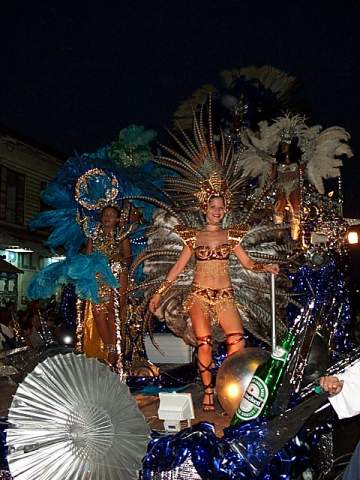
This carnival was born at the same time as Guyana itself. When Europe set out to conquer America, it took with it the christian's tradition of carnival.
The colonists celebrated then the carnival in front of the slaves who didn't have the right to participate to it. But can we forbid the laughter, even suffocated, the dance, the party? The colonists were afraid from these evenings of fiest, so they forbade some dances, destroyed drums... But the universal spirit of the carnival was there. It joined the African fiest of the harvest and the fertility. The Christian's carnival, imported by the conquest, was only resuming these old parties so ancient for the man. Interbreeding of European and African party, the carnival acquired an appropriate personality whom we can find only in Guyana.
It is doubtless the longest carnival of the world. He begins after Epiphany to end the Ash Wednesday.
It is doubtless the longest carnival of the world. He begins after Epiphany to end the Ash Wednesday.
The carnival is also a memory's place. Its characters are pulled out by the history of the country. For example, "neg maron" represents the slaves who, during the slavery period, ran away, have " marroné ". Some neg' marons became famous so the tradition lent them extraordinary powers. In the parade of the carnival, "neg maron" has a red banner in his hair, a kalimbé in the size and especially he covers his body of soot's oil. He uses this black and brilliant mixture to make the most curious spectator move back and so clear the passage.
Next to traditional costumes are born the inventions of the modern carnival. New costumes make more reference to the media, to the society than to the history of the country.
Next to traditional costumes are born the inventions of the modern carnival. New costumes make more reference to the media, to the society than to the history of the country.
Guyana lives at the tempo of its carnival. Musicians, wardrobe master work all year to honor her Majesty Vaval who is burnt the day of Ash Wednesday and who resuscitates theEpiphanie's day of the next year.
Monday, March 9, 2009
The guadeloupean's carnival
Enjoyment and mockery ( sé kannaval ki ka rivé,toùt moun an lari-la...).
The carnival called by the inhabitants of Guadeloupe ' Kannaval ' or simply ' Vaval' begins the Epiphany's day and finishes the wenesday of ashes. This year, since January 1st, the carnavaliers groups, gathered.
The carnival was created when the African slaves were deported to the Antilles to be used by the colonists. At the beginning,the carnival was only practised by the colonists. More and more , the slaves began to celebrate the carnival! They brought a totally different vision to the carnival, with drums, songs and masks. This moment is always considered as a liberation, in fact they laughed from colonists through their suits.
Progress of the festivities:
Masks are omnipresent during the carnival (Some young people takes advantage from it to earn some money). The most important places are "The cities of Pointe-à-Pitre" and "Basse-Terre" . Several competitions are organized like the election of king, queen, the best group, the best suit, the best music etc...
The elected Queen has got to throne at the head of the parades during fat tuesday. The music of the parades is particular. Guadeloupean use diverse objects of recovery (bottles, tins of plastic, salty meat of different size).
The groups are divided into three categories according to their music:
- the groups with copper. They use instruments craft as snare drums, big plastic drums.
- the groups with skins. They use small drums covered with animal's skins, with traditional instruments (exemple: whipes).
- the groups of synthesizers .These groups exist for ten years. Besides the traditional instruments, they have appealed to more modern instruments.
Monday is dedicated to the comic marriages. Couples appear in front of a guy disguised as an officer of registry office and another one in priest. The man is disguised as a woman and the woman is dressed up as a man.
The Shrove Tuesday is the most important part of the carnival due to the musical level, the disguises, the originality... The festivities are opened by the carnival's queenThe culinary speciality of Shrove Tuesday is the consumption of doughnuts.
The next day, on Ash Wednesdays the crowd disguised in black and white, in sign of mourning, burns the effigy of king Vaval.
The carnival called by the inhabitants of Guadeloupe ' Kannaval ' or simply ' Vaval' begins the Epiphany's day and finishes the wenesday of ashes. This year, since January 1st, the carnavaliers groups, gathered.
The carnival was created when the African slaves were deported to the Antilles to be used by the colonists. At the beginning,the carnival was only practised by the colonists. More and more , the slaves began to celebrate the carnival! They brought a totally different vision to the carnival, with drums, songs and masks. This moment is always considered as a liberation, in fact they laughed from colonists through their suits.
Progress of the festivities:
Masks are omnipresent during the carnival (Some young people takes advantage from it to earn some money). The most important places are "The cities of Pointe-à-Pitre" and "Basse-Terre" . Several competitions are organized like the election of king, queen, the best group, the best suit, the best music etc...
The elected Queen has got to throne at the head of the parades during fat tuesday. The music of the parades is particular. Guadeloupean use diverse objects of recovery (bottles, tins of plastic, salty meat of different size).
The groups are divided into three categories according to their music:
- the groups with copper. They use instruments craft as snare drums, big plastic drums.
- the groups with skins. They use small drums covered with animal's skins, with traditional instruments (exemple: whipes).
- the groups of synthesizers .These groups exist for ten years. Besides the traditional instruments, they have appealed to more modern instruments.
Monday is dedicated to the comic marriages. Couples appear in front of a guy disguised as an officer of registry office and another one in priest. The man is disguised as a woman and the woman is dressed up as a man.
The Shrove Tuesday is the most important part of the carnival due to the musical level, the disguises, the originality... The festivities are opened by the carnival's queenThe culinary speciality of Shrove Tuesday is the consumption of doughnuts.
The next day, on Ash Wednesdays the crowd disguised in black and white, in sign of mourning, burns the effigy of king Vaval.
Wednesday, March 4, 2009
Venice's carnival: nowadays
As everybody knows, we are actually in the Lent period. Carnivals are finished, and for the luckiest one, you have been able to take part at one of those important events, beginning once more time every years.
In a few days, we'll show you how we did it in our school, but actually, we'll just finish the description of the Venice's carnival. ;)
First, we should say that carnival no longer mean that a doge has been victorious, it is just a touristic event. A world of dreams opens its doors for a few days, allowing people to drink and eat delicious things, to flirt, to escape from real life.
The mask is the symbol of the carnival. Every year around the world, anyone understand that this bauta, even not knowing the real name, is associated to Venice. It's possible for mascherari to make impressing masks which are usefull only a few days every year.
Some important events occurs during those few days. This year, the official edition of the carnival was: "Sensation, 6 senses for 6 districts" The aim is to divide the city in different geographic parts where people can profit differently of the carnival. If you want to use your nose, many parfums could be smelt in Santa croce, whereas you can hear beautiful musics at Dorsoduro, taste wonderful food at Cannaregio, touch at Castello, watch at san Polo and think at san Marco. Everyone should find what is the most interesting for him/her.
There is also a something for young children: the best mzsked and costumed child earn an award, many art expositions are opened, some people are costumed in dinausorus ( you need to see it to believe it!), many animations for both children and their parents, theatres are opened, the angel flight is during the first sunday...
The only problem is to stay there... Hotels are all empty many months ago!!!
In a few days, we'll show you how we did it in our school, but actually, we'll just finish the description of the Venice's carnival. ;)
First, we should say that carnival no longer mean that a doge has been victorious, it is just a touristic event. A world of dreams opens its doors for a few days, allowing people to drink and eat delicious things, to flirt, to escape from real life.
The mask is the symbol of the carnival. Every year around the world, anyone understand that this bauta, even not knowing the real name, is associated to Venice. It's possible for mascherari to make impressing masks which are usefull only a few days every year.
Some important events occurs during those few days. This year, the official edition of the carnival was: "Sensation, 6 senses for 6 districts" The aim is to divide the city in different geographic parts where people can profit differently of the carnival. If you want to use your nose, many parfums could be smelt in Santa croce, whereas you can hear beautiful musics at Dorsoduro, taste wonderful food at Cannaregio, touch at Castello, watch at san Polo and think at san Marco. Everyone should find what is the most interesting for him/her.
There is also a something for young children: the best mzsked and costumed child earn an award, many art expositions are opened, some people are costumed in dinausorus ( you need to see it to believe it!), many animations for both children and their parents, theatres are opened, the angel flight is during the first sunday...
The only problem is to stay there... Hotels are all empty many months ago!!!
Wednesday, January 21, 2009
Additional informations about Rio de Janeiro...

About consequences of the rio de janeiro's carnival in the favelas, we have seen that an association of musicians was created very quickly in one of the most violent favelas. It's Afro Reggae, born in 1993 creating a cultural center where young people can play music and percussion in groups. It's an alternative to gang war, killing every year thousands of teenagers and other people suffering of narcotraficants, violence, etc...
They have also made an album, Nova Cara, a developped samba's group, theatre companies, and many other projects helping teenagers in their everyday life.
If it has been possible, we think that it's because carnivals are in Rio de Janeiro a phenomen promoting dance and music arts, an issue to many problems of these brazilians.
They have also made an album, Nova Cara, a developped samba's group, theatre companies, and many other projects helping teenagers in their everyday life.
If it has been possible, we think that it's because carnivals are in Rio de Janeiro a phenomen promoting dance and music arts, an issue to many problems of these brazilians.
Informations taken from "Courrier International".
Friday, January 16, 2009
Venice carnival
Venice carnival

First mention to the Venice’s carnival started in the beginning of the XII century. It celebrates the victory doge Vital Michiel II on patriarch Ulrico in Aquilea in the year 1162. Each year, in memory, Ulrico’s successor had to send to the Venice’s doge a lot of animal, due to his defeat.
This cattle was slaughtered when it arrived, cooked, and distributed to venetians during a big banquet. This Thursday is also called Berlingaccio, meaning insolent and ridiculous, to indicate the meaning of this day to the enemies of Venice. In 1296, senate attributes carnival’s day as holiday.
The oldest reference to the venetian’s mask dates back to 1268. It was well established in 1436 when mask makers or “mascareri” were officially recognized with their own guilt. This white mask named “bauta” has a special form that modifies voices and this way, people can be totally anonymous. The practice of wearing mask was the most important at the end of XVIII century.
Since this moment, everybody from every social class could mingle. The carnival was the occasion to flirt without being recognized. In addition to their mask, venetians have also a hood, a tricorn and a cape.
The angel or dove flight consists in the walk of a Turkish prisoner on a rope from the Bell tower to doge palace, in front of it. If he could arrive alive, freedom was offered to him. Otherwise, if he felt down… well, he was dead. After, this prisoner was substituted by a volunteer symbolizing peace. Then, a mechanic dove replaces this guy.
Finally, the carnival took end in 1797, when Campoformio declaration merges Venice into Austria. Many traditions were forbidden, but parties in palaces continued till 1861, when Italia became an unified country. Since this day, nobody made any reference to this carnival.
We could see the carnival only since 1979. Many associations decided to recreate the lost traditions. Nowadays, this very touristic event join glamour and XVIII century’s traditions.
Subscribe to:
Posts (Atom)
